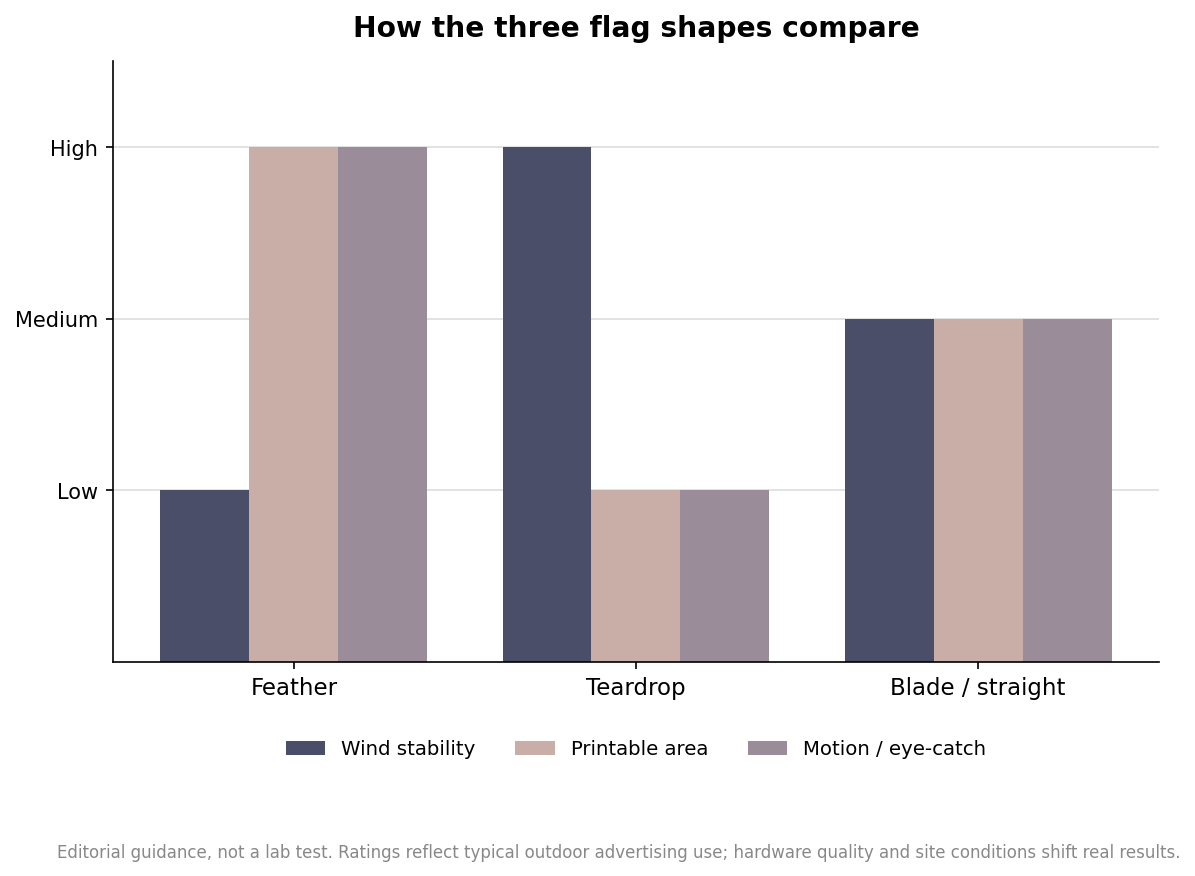
Feather, teardrop, and blade flags share a pole and a footprint, and buyers treat them as interchangeable until the first windy afternoon proves they are not. The three shapes are built for different jobs: one is made to move and be read from far off, one is made to stand firm when the wind picks up, and one splits the difference. Ordering the wrong shape for your site means either a flag no one can read or one that thrashes itself to an early retirement. This guide lays out where each shape wins so you can match the flag to the ground it will stand on.
Three shapes, three jobs
A feather flag has the tall, curved silhouette its name suggests: a roughly rectangular body with the top and bottom sweeping in from one edge, carried on a pole that arcs forward at the top. A teardrop flag is a rounded droplet, wide and curved at the top and tapering down at about a 45-degree angle, held taut top and bottom on its pole. A blade, or straight, flag is a simple rectangular sail on an upright pole, closest to a traditional banner stood on end. All three plant in the same bases and cover the same patch of sidewalk, but the way each holds the wind and carries a message is where they diverge.
Feather flags: height and movement
Feather flags give you the most vertical canvas and the most motion, which is exactly what you want along a busy road or a row of storefronts where you are competing for a glance. The tall body suits stacked, elongated designs, and the constant flutter draws the eye in the way a static sign cannot. That same movement is the weakness: in gusty conditions the fabric whips hard enough that the text blurs, and a poorly tensioned flag can wrap around its own pole and stop advertising anything at all. Feather flags are at their best in light-to-moderate wind and in spots where the animation is an asset rather than a liability.
Teardrop flags: the wind-resistant workhorse
A teardrop flag holds its form when a feather flag would be thrashing. Because the fabric is fixed both at the top and at the bottom of the curved pole, it stays taut and keeps its shape, which is why it is the default choice for beaches, open lots, and anywhere exposed to steady gusts. The trade-off is space: the droplet shape offers less printable area and is top-heavy, so it rewards short, punchy messages — a single word like “Sale” or “Open,” a logo, a price — rather than a paragraph. If your location is windy and your message is brief, the teardrop is usually the right call.
Blade flags: the readable middle ground
The blade, or straight, flag is the most formal of the three and the easiest to read at close range. Its rectangular body keeps text and logos undistorted and holds more of the message at eye level, which suits event entrances, dealership rows, and grand openings where people approach on foot. It moves less than a feather flag, so it is calmer and steadier without matching a teardrop’s outright wind resistance. Think of it as the option when legibility and a tidier look matter more than either maximum motion or maximum stability.
Placement and quantity matter as much as shape. A single flag is easy to miss, while a row of three to five identical flags spaced roughly eight to ten feet apart reads as a deliberate installation and holds a frontage far better than one flag alone. Alternate a logo flag with a message flag if you want to carry two ideas at once, and keep the run on the approach side so drivers and walkers meet the faces head-on rather than edge-on. For events, cluster the flags at the entrance, where the decision to turn in actually gets made.
Matching size and base to the site
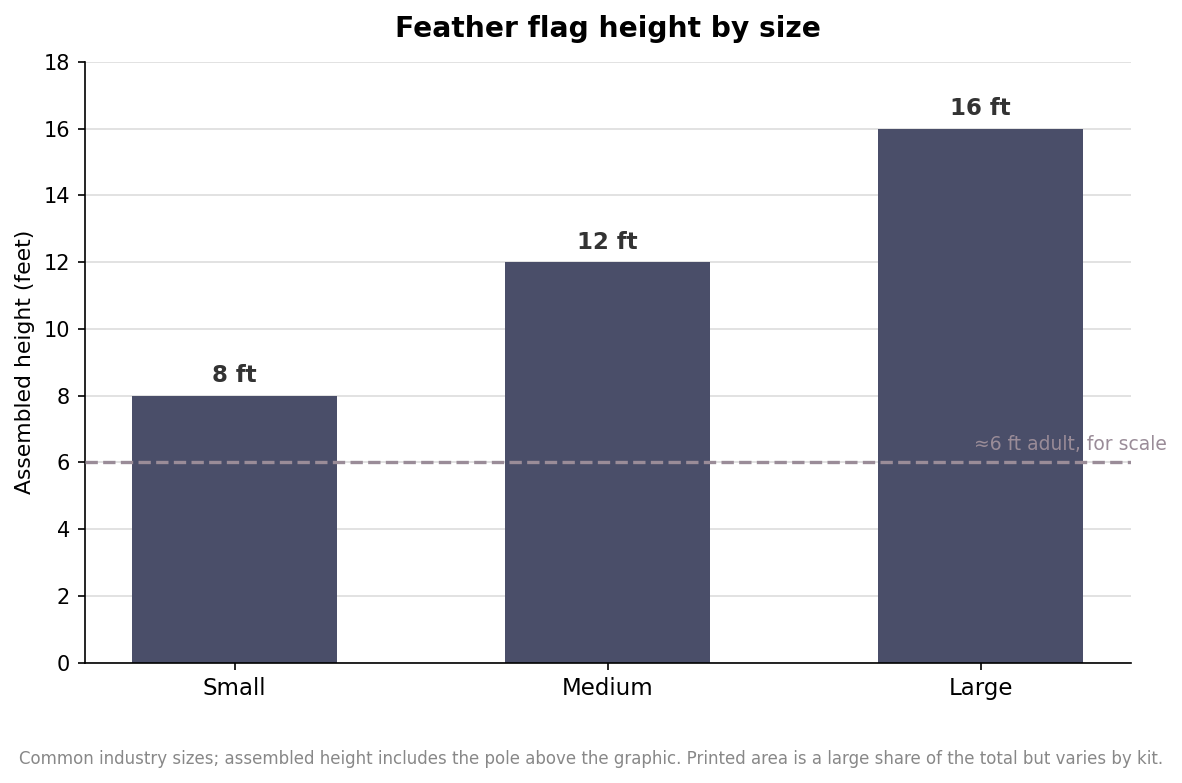
Once the shape is settled, size follows the viewing distance. Feather flags come in three common heights — roughly 8 feet, 12 feet, and 16 feet — and the taller the flag, the farther off it reads and the more wind load it catches. An 8-foot flag suits a doorway or a sidewalk where viewers are close; a 12-foot flag is the everyday roadside standard; a 16-foot flag commands a highway frontage but demands a heavier base and calmer conditions to stay upright and legible.
The base has to match the surface, not just the flag. A ground spike drives into grass or soil and is the most secure option outdoors; an X-shaped cross base handles hard indoor floors; and a fillable water or weight base steadies a flag on pavement outdoors, where nothing can be driven into the ground. In exposed, windy spots, size down and weight up rather than reaching for the tallest flag, and lean toward a teardrop — the assembly that stays readable in a gust does more for you than the one that is merely bigger.
Nearly all of these flags are printed on knitted polyester by dye-sublimation, which drives the ink into the fibers so color shows through to the back at reduced strength. If you need both faces at full strength and correctly oriented, ask for a double-sided build with a block-out liner sewn between two printed layers. As always, confirm the pole material, base type, and whether the price includes the graphic or the hardware alone before you compare quotes, since a cheap flag with the kit sold separately is rarely the bargain it looks like.
Finally, treat an outdoor flag as a consumable. Under constant sun and wind the colors fade and the trailing edge frays over months of exposure, which is why many businesses reorder the graphic on a cycle while keeping the same pole and base. Buying a spare flag with the first run costs little and keeps a sun-bleached, frayed flag from quietly working against the storefront it is meant to promote.