A feather flag looks simple, a printed sail on a springy pole, but three material decisions quietly determine whether yours reads cleanly from across a parking lot, survives a windy month, and still looks sharp a year later: the fabric, whether it is printed on one side or two, and how it is finished for outdoor life. Those choices matter more than the artwork itself, because a beautiful design on the wrong build fades, frays, or reads backward to half the people who see it.
The fabric under the print
Almost every feather flag is printed on a lightweight knitted polyester, commonly around 115 gsm, which is roughly a four-ounce fabric. The knit matters: unlike solid vinyl, it flutters in a light breeze and lets wind pass through the weave, which is what makes the flag move and read from a distance instead of standing like a rigid board. The print method is dye-sublimation, where heat presses the ink into the polyester fibers at a molecular level rather than laying it on the surface. Because the color penetrates the weave, it resists peeling and cracking, and paired with UV-stable inks it holds up in direct sun far better than a surface print. Finishing counts as much as the print here: a quality flag closes the edges with a sewn hem and a reinforced pole sleeve rather than a raw cut, because the leading edge and the sleeve absorb the most flex and are the first places a cheap flag frays. The one catch of that deep penetration is show-through, which leads straight to the single-versus-double-sided decision.
One side or two, and the show-through question
Because dye-sublimation ink soaks through the fabric, a single-sided flag shows a faint mirror image on the back: text reads backward and logos flip. That is normal rather than a defect, and it is perfectly fine when the flag stands against a wall or fence or only ever faces one direction. A double-sided flag solves it with three-layer construction, a printed front panel and a printed back panel with a specialist blockout interliner stitched between them to stop the two images bleeding into each other. That build even lets you run different artwork on each face, such as two languages or a seasonal message. The cost is real: a double-sided flag costs more and is noticeably heavier, and the added weight means you should step up one base grade to keep it standing. Choose single-sided for budget, wall-mounted, single-direction placements; choose double-sided for medians, walkways, and junctions where people approach from both sides, or whenever a phone number or QR code has to stay legible either way.
What decides how long it lasts outside
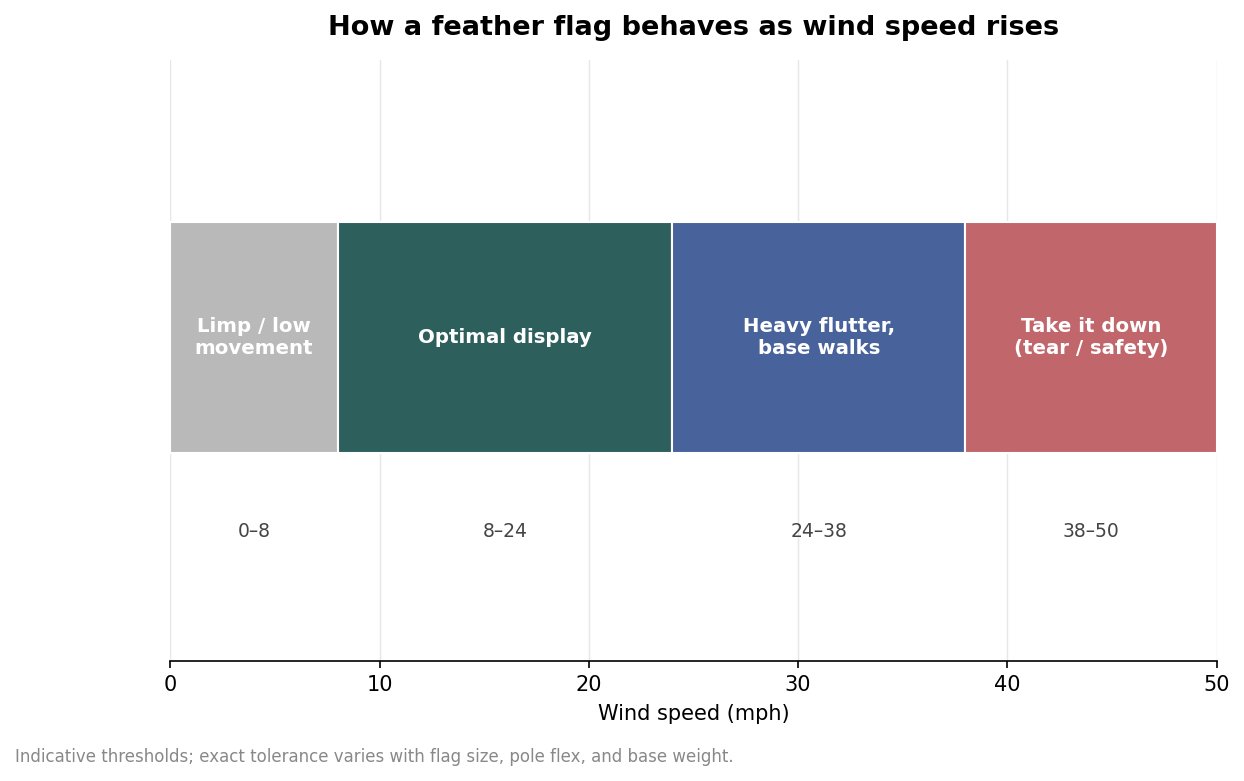
Two forces age a feather flag, wind and sunlight, and understanding the first also solves the pole-wrap complaint. On wind, the sweet spot sits roughly between 8 and 24 mph, where the flag flutters steadily and displays its message. From about 25 to 38 mph it flaps hard and the base begins to walk, and beyond roughly 40 mph it sways enough to become a tear and safety risk and should come down. A ball-bearing swivel at the pole top lets the flag rotate freely to shed gusts, which both reduces stress and keeps it from winding around the pole. On sunlight, dye-sublimation with UV-resistant inks is what keeps the color from washing out, but no print is permanent outdoors. A realistic service life runs from about six months under harsh, full-sun, coastal-wind exposure to as long as two years in mild, sheltered spots, and simply bringing flags in during storms and the off-season is the cheapest way to reach the top of that range. Stitching quality tells here as well, since a double-stitched leading edge and a bartacked sleeve resist the constant flexing that eventually splits a single-stitched seam.
Reading the size chart before you order
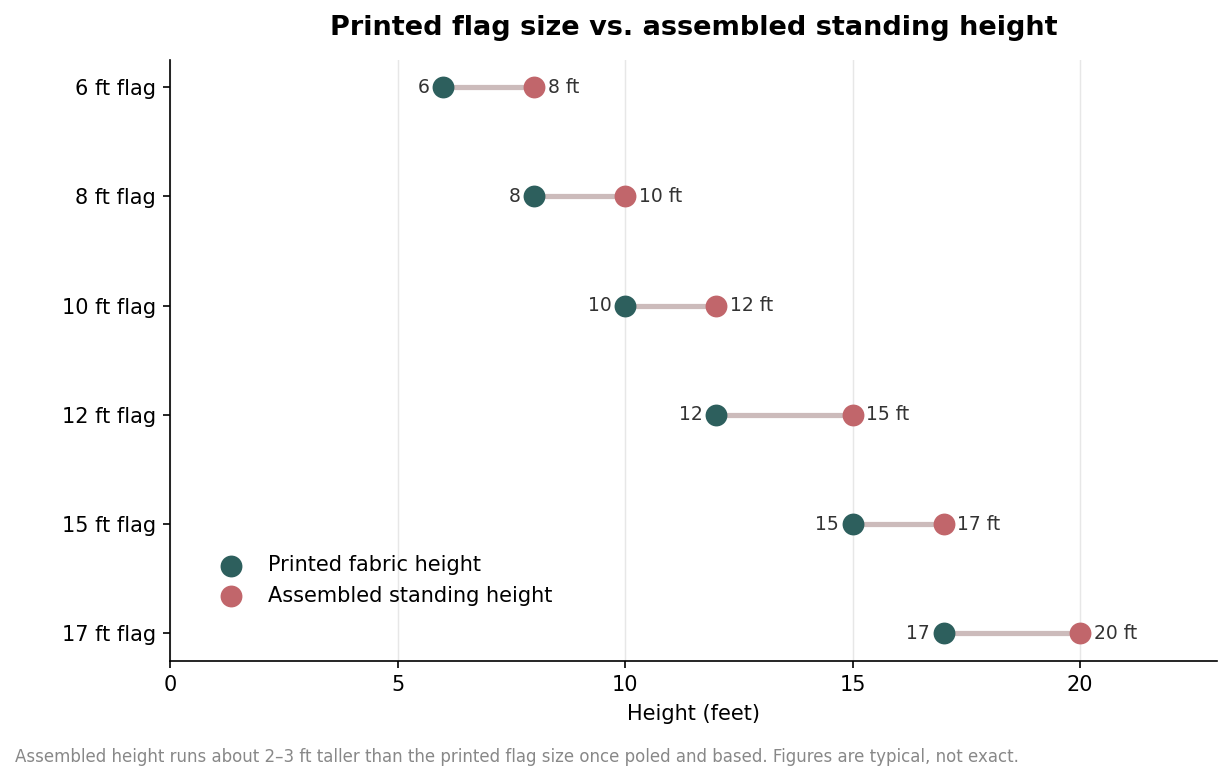
The most common ordering mistake is confusing flag size with finished height. The size on a listing, whether 8, 10, 12, or 15 feet, is the length of the printed fabric, not how tall the display stands once assembled. After the fabric is sleeved onto the pole and set in a base, assume the standing height lands about two to three feet taller, so an 8-foot flag stands near 10 feet, a 12-foot flag near 15, and a 15-foot flag near 17. Small 6-to-8-foot flags suit indoor showrooms and covered entrances; the 10-to-12-foot mid sizes are the everyday workhorses for storefronts and events; and 15-to-17-foot flags earn their keep on open lots and near highways where you are competing against distance. Because the shape is tall and narrow, design vertically: a few large words such as OPEN or SALE stacked down the flag stay readable far longer than a dense, detailed layout.
Putting it together for your use case
A retail storefront facing the street from one direction is well served by a single-sided mid-size flag, stepped up one base grade if it stands on hard concrete in open wind. A dealership lot or an event island with traffic on both sides calls for a double-sided flag, sized larger for visibility, with the base matched to the surface. A real-estate open house that moves from site to site favors a smaller single-sided flag on a portable base for quick setup and teardown. Whatever the application, settle the fabric, the number of sides, and the size before you finalize artwork, because those three choices set both your readable area and your budget. And because wind and sun at your specific location decide the outcome, treat every figure here as an indicative range and let a sample in your own conditions have the final say.