Category: Uncategorized

  • What Custom Feather Flags Are Made Of: Fabric, Sides, and Outdoor Life

    What Custom Feather Flags Are Made Of: Fabric, Sides, and Outdoor Life

    A feather flag looks simple, a printed sail on a springy pole, but three material decisions quietly determine whether yours reads cleanly from across a parking lot, survives a windy month, and still looks sharp a year later: the fabric, whether it is printed on one side or two, and how it is finished for outdoor life. Those choices matter more than the artwork itself, because a beautiful design on the wrong build fades, frays, or reads backward to half the people who see it.

    The fabric under the print

    Almost every feather flag is printed on a lightweight knitted polyester, commonly around 115 gsm, which is roughly a four-ounce fabric. The knit matters: unlike solid vinyl, it flutters in a light breeze and lets wind pass through the weave, which is what makes the flag move and read from a distance instead of standing like a rigid board. The print method is dye-sublimation, where heat presses the ink into the polyester fibers at a molecular level rather than laying it on the surface. Because the color penetrates the weave, it resists peeling and cracking, and paired with UV-stable inks it holds up in direct sun far better than a surface print. Finishing counts as much as the print here: a quality flag closes the edges with a sewn hem and a reinforced pole sleeve rather than a raw cut, because the leading edge and the sleeve absorb the most flex and are the first places a cheap flag frays. The one catch of that deep penetration is show-through, which leads straight to the single-versus-double-sided decision.

    One side or two, and the show-through question

    Because dye-sublimation ink soaks through the fabric, a single-sided flag shows a faint mirror image on the back: text reads backward and logos flip. That is normal rather than a defect, and it is perfectly fine when the flag stands against a wall or fence or only ever faces one direction. A double-sided flag solves it with three-layer construction, a printed front panel and a printed back panel with a specialist blockout interliner stitched between them to stop the two images bleeding into each other. That build even lets you run different artwork on each face, such as two languages or a seasonal message. The cost is real: a double-sided flag costs more and is noticeably heavier, and the added weight means you should step up one base grade to keep it standing. Choose single-sided for budget, wall-mounted, single-direction placements; choose double-sided for medians, walkways, and junctions where people approach from both sides, or whenever a phone number or QR code has to stay legible either way.

    What decides how long it lasts outside

    Two forces age a feather flag, wind and sunlight, and understanding the first also solves the pole-wrap complaint. On wind, the sweet spot sits roughly between 8 and 24 mph, where the flag flutters steadily and displays its message. From about 25 to 38 mph it flaps hard and the base begins to walk, and beyond roughly 40 mph it sways enough to become a tear and safety risk and should come down. A ball-bearing swivel at the pole top lets the flag rotate freely to shed gusts, which both reduces stress and keeps it from winding around the pole. On sunlight, dye-sublimation with UV-resistant inks is what keeps the color from washing out, but no print is permanent outdoors. A realistic service life runs from about six months under harsh, full-sun, coastal-wind exposure to as long as two years in mild, sheltered spots, and simply bringing flags in during storms and the off-season is the cheapest way to reach the top of that range. Stitching quality tells here as well, since a double-stitched leading edge and a bartacked sleeve resist the constant flexing that eventually splits a single-stitched seam.
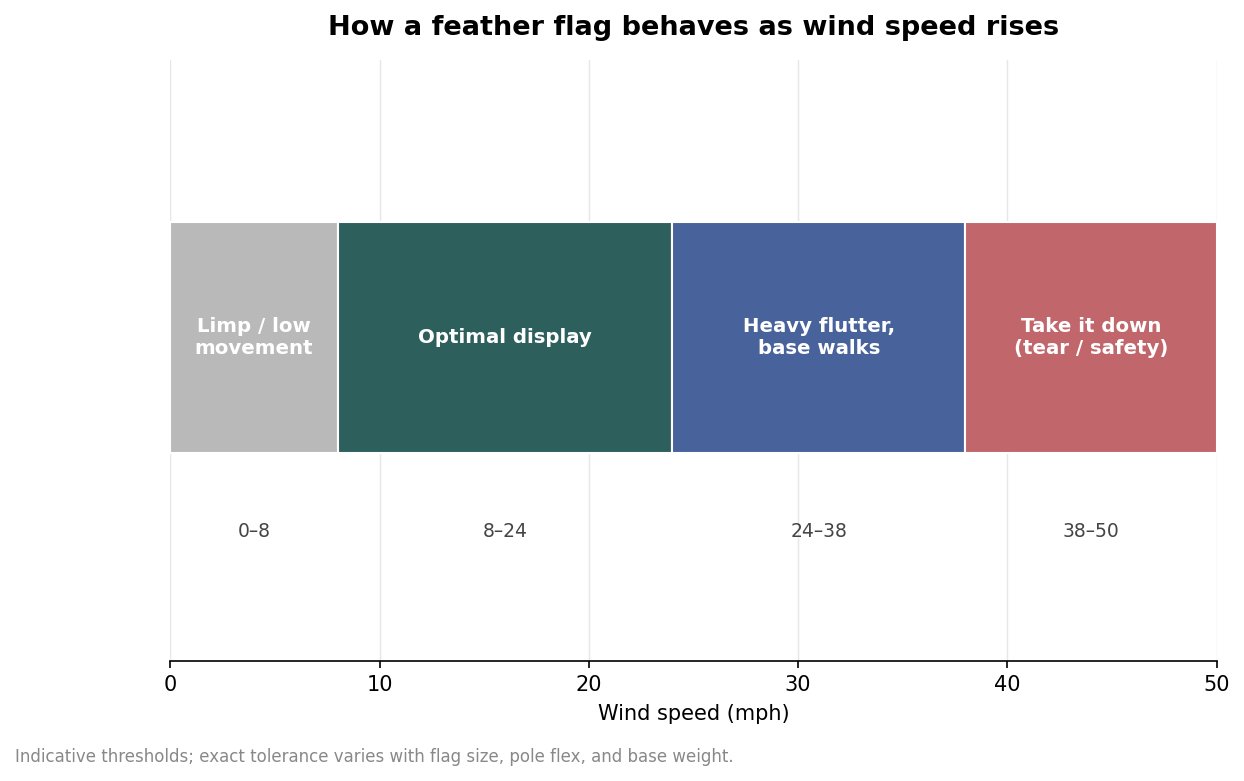
    Segmented horizontal bar showing feather flag behavior across wind speeds: limp below 8 mph, optimal 8 to 24 mph, heavy flutter 24 to 38 mph, and take-down beyond 38 mph
    Feather flags display best in an 8 to 24 mph breeze and should come down beyond roughly 40 mph.

    Reading the size chart before you order

    The most common ordering mistake is confusing flag size with finished height. The size on a listing, whether 8, 10, 12, or 15 feet, is the length of the printed fabric, not how tall the display stands once assembled. After the fabric is sleeved onto the pole and set in a base, assume the standing height lands about two to three feet taller, so an 8-foot flag stands near 10 feet, a 12-foot flag near 15, and a 15-foot flag near 17. Small 6-to-8-foot flags suit indoor showrooms and covered entrances; the 10-to-12-foot mid sizes are the everyday workhorses for storefronts and events; and 15-to-17-foot flags earn their keep on open lots and near highways where you are competing against distance. Because the shape is tall and narrow, design vertically: a few large words such as OPEN or SALE stacked down the flag stay readable far longer than a dense, detailed layout.
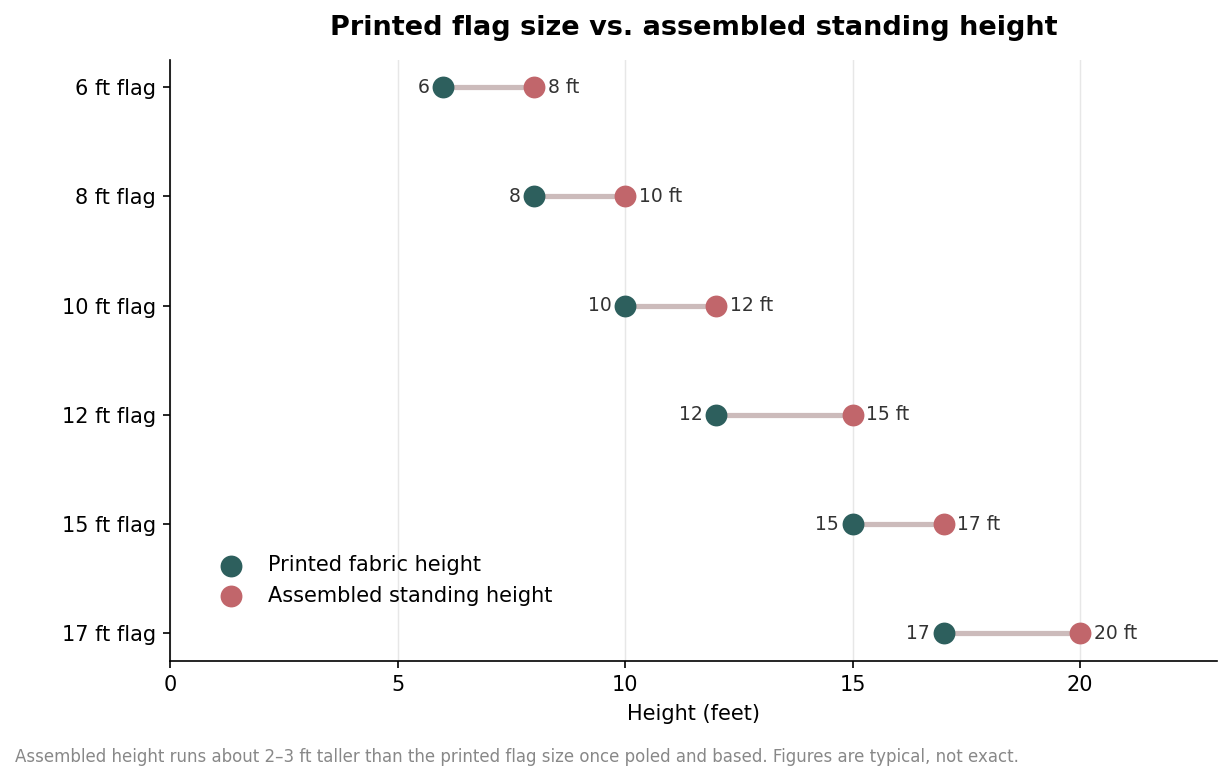
    Dumbbell chart comparing printed fabric flag height with assembled standing height for 6, 8, 10, 12, 15, and 17 foot flags, showing a 2 to 3 foot gap
    The listed flag size is the fabric length; the assembled display stands about 2 to 3 feet taller.

    Putting it together for your use case

    A retail storefront facing the street from one direction is well served by a single-sided mid-size flag, stepped up one base grade if it stands on hard concrete in open wind. A dealership lot or an event island with traffic on both sides calls for a double-sided flag, sized larger for visibility, with the base matched to the surface. A real-estate open house that moves from site to site favors a smaller single-sided flag on a portable base for quick setup and teardown. Whatever the application, settle the fabric, the number of sides, and the size before you finalize artwork, because those three choices set both your readable area and your budget. And because wind and sun at your specific location decide the outcome, treat every figure here as an indicative range and let a sample in your own conditions have the final say.
  • Feather vs Teardrop vs Blade Flags: Which Shape to Order and When

    Feather vs Teardrop vs Blade Flags: Which Shape to Order and When

    Feather, teardrop, and blade flags share a pole and a footprint, and buyers treat them as interchangeable until the first windy afternoon proves they are not. The three shapes are built for different jobs: one is made to move and be read from far off, one is made to stand firm when the wind picks up, and one splits the difference. Ordering the wrong shape for your site means either a flag no one can read or one that thrashes itself to an early retirement. This guide lays out where each shape wins so you can match the flag to the ground it will stand on.

    Three shapes, three jobs

    A feather flag has the tall, curved silhouette its name suggests: a roughly rectangular body with the top and bottom sweeping in from one edge, carried on a pole that arcs forward at the top. A teardrop flag is a rounded droplet, wide and curved at the top and tapering down at about a 45-degree angle, held taut top and bottom on its pole. A blade, or straight, flag is a simple rectangular sail on an upright pole, closest to a traditional banner stood on end. All three plant in the same bases and cover the same patch of sidewalk, but the way each holds the wind and carries a message is where they diverge.

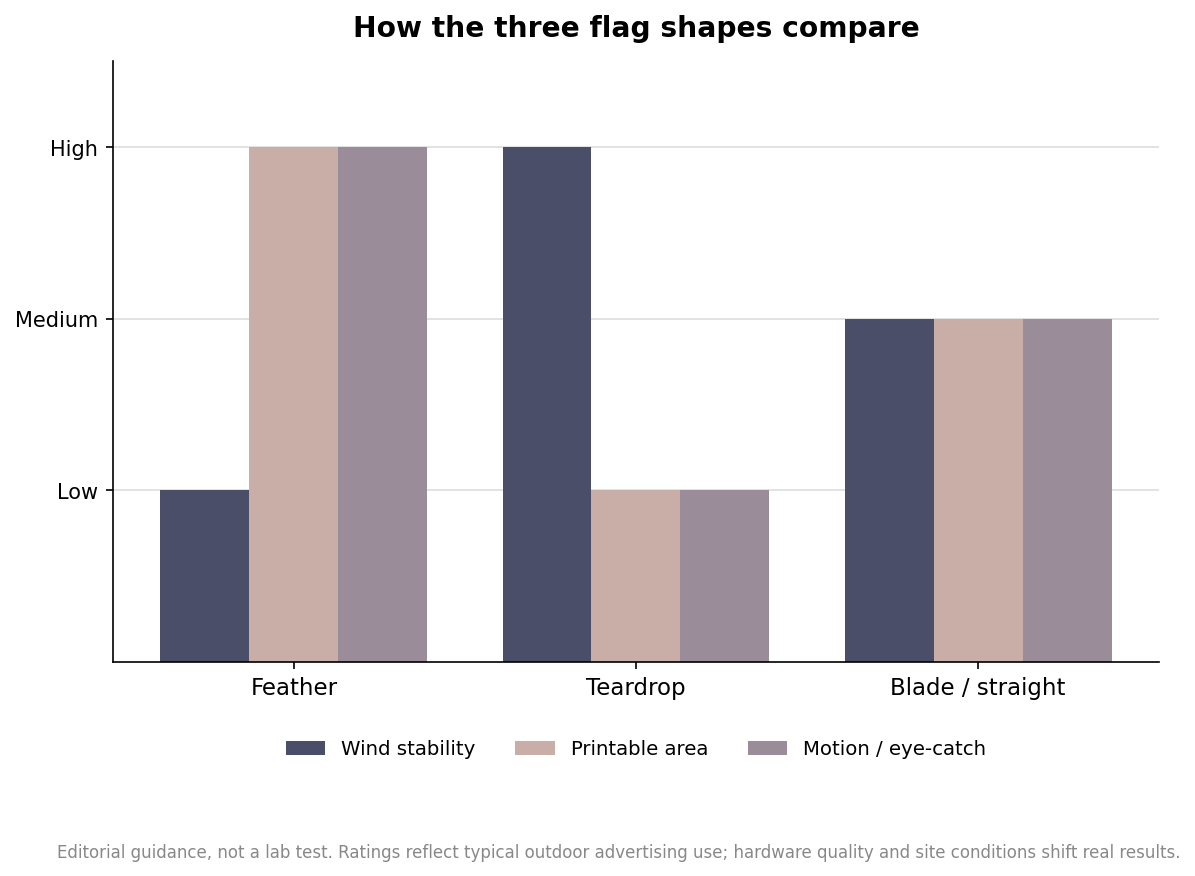
    Grouped bar chart comparing feather, teardrop, and blade flags on wind stability, printable area, and motion
    How the three shapes trade off wind stability, printable area, and eye-catching motion.

    Feather flags: height and movement

    Feather flags give you the most vertical canvas and the most motion, which is exactly what you want along a busy road or a row of storefronts where you are competing for a glance. The tall body suits stacked, elongated designs, and the constant flutter draws the eye in the way a static sign cannot. That same movement is the weakness: in gusty conditions the fabric whips hard enough that the text blurs, and a poorly tensioned flag can wrap around its own pole and stop advertising anything at all. Feather flags are at their best in light-to-moderate wind and in spots where the animation is an asset rather than a liability.

    Teardrop flags: the wind-resistant workhorse

    A teardrop flag holds its form when a feather flag would be thrashing. Because the fabric is fixed both at the top and at the bottom of the curved pole, it stays taut and keeps its shape, which is why it is the default choice for beaches, open lots, and anywhere exposed to steady gusts. The trade-off is space: the droplet shape offers less printable area and is top-heavy, so it rewards short, punchy messages — a single word like “Sale” or “Open,” a logo, a price — rather than a paragraph. If your location is windy and your message is brief, the teardrop is usually the right call.

    Blade flags: the readable middle ground

    The blade, or straight, flag is the most formal of the three and the easiest to read at close range. Its rectangular body keeps text and logos undistorted and holds more of the message at eye level, which suits event entrances, dealership rows, and grand openings where people approach on foot. It moves less than a feather flag, so it is calmer and steadier without matching a teardrop’s outright wind resistance. Think of it as the option when legibility and a tidier look matter more than either maximum motion or maximum stability.

    Placement and quantity matter as much as shape. A single flag is easy to miss, while a row of three to five identical flags spaced roughly eight to ten feet apart reads as a deliberate installation and holds a frontage far better than one flag alone. Alternate a logo flag with a message flag if you want to carry two ideas at once, and keep the run on the approach side so drivers and walkers meet the faces head-on rather than edge-on. For events, cluster the flags at the entrance, where the decision to turn in actually gets made.

    Matching size and base to the site

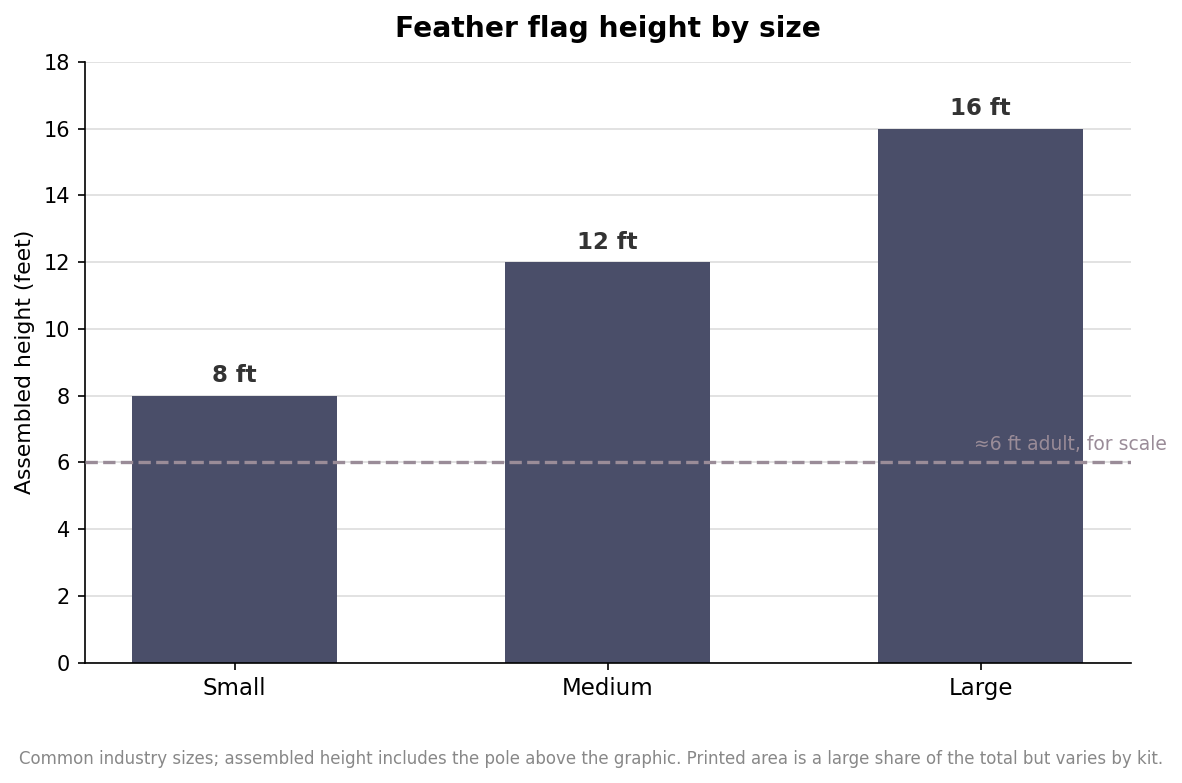
    Once the shape is settled, size follows the viewing distance. Feather flags come in three common heights — roughly 8 feet, 12 feet, and 16 feet — and the taller the flag, the farther off it reads and the more wind load it catches. An 8-foot flag suits a doorway or a sidewalk where viewers are close; a 12-foot flag is the everyday roadside standard; a 16-foot flag commands a highway frontage but demands a heavier base and calmer conditions to stay upright and legible.

    Bar chart of feather flag assembled height by size: small 8 feet, medium 12 feet, large 16 feet, with a 6-foot adult reference line
    Common feather flag heights, with a six-foot adult marked for scale.

    The base has to match the surface, not just the flag. A ground spike drives into grass or soil and is the most secure option outdoors; an X-shaped cross base handles hard indoor floors; and a fillable water or weight base steadies a flag on pavement outdoors, where nothing can be driven into the ground. In exposed, windy spots, size down and weight up rather than reaching for the tallest flag, and lean toward a teardrop — the assembly that stays readable in a gust does more for you than the one that is merely bigger.

    Nearly all of these flags are printed on knitted polyester by dye-sublimation, which drives the ink into the fibers so color shows through to the back at reduced strength. If you need both faces at full strength and correctly oriented, ask for a double-sided build with a block-out liner sewn between two printed layers. As always, confirm the pole material, base type, and whether the price includes the graphic or the hardware alone before you compare quotes, since a cheap flag with the kit sold separately is rarely the bargain it looks like.

    Finally, treat an outdoor flag as a consumable. Under constant sun and wind the colors fade and the trailing edge frays over months of exposure, which is why many businesses reorder the graphic on a cycle while keeping the same pole and base. Buying a spare flag with the first run costs little and keeps a sun-bleached, frayed flag from quietly working against the storefront it is meant to promote.

  • Why Your Flag Keeps Wrapping Around Its Pole

    A wrapped flag is the single most common complaint in this trade, and the single most misdiagnosed. People replace the fabric, and the new one wraps too.

    What is actually happening

    A flag has to point downwind. If the whole assembly can rotate, the wind does that for you — the flag swings round and streams cleanly no matter which way the gust comes from.

    If it cannot rotate, the fabric has nowhere to go but around the mast. Once it has wrapped one turn it is held there by its own tension, and it stays wrapped until somebody walks out and unwinds it by hand. Every gust after that tightens it.

    The three things to check

    First, the base. It should have a free-turning collar, and you should be able to spin the pole by hand with almost no resistance. A rusted, gritted or seized swivel behaves exactly like no swivel at all — rinse it, dry it, and try again before replacing anything.

    Second, the sleeve. A flag sewn too tight on the pole cannot settle. It should slide down and sit without being forced.

    Third, the height. A very tall flag on a short pole section run has more fabric than the rig can control, and it will bind even with a good swivel.

    Fixing it

    In most cases the answer is a new base with a working swivel, which costs a fraction of a new flag and takes a minute to swap. Keep the fabric; there is usually nothing wrong with it.

    If the site is genuinely exposed and the wrapping continues, drop a height. A 3.4m flag that flies all year is worth more than a 5m flag somebody has to unwind twice a week.

  • The Complete Buyer’s Guide to Custom Feather Flags

    Almost every flag that disappoints its owner was specified correctly on the print and incorrectly on everything else.

    Four decisions carry the outcome. Work through them in this order, because each one narrows the next.

    Shape is decided by the wind you actually have

    The curved feather flag is the default because movement is what catches an eye. It needs air, though: on a still day in a sheltered courtyard it hangs down the pole and the artwork folds in on itself.

    The teardrop is tensioned back to a fixed point, so it holds its outline with no wind at all. That makes it the honest answer for indoor halls, courtyards and anywhere surrounded by buildings. The rectangle and the blade give the largest flat print area, which is what you want when the flag has to carry an address or an opening time rather than a logo.

    Height is decided by what stands between the flag and the reader

    2.4m is a shopfront and indoor size. 3.4m is the all-round default and covers most sites. 4.2m and 5m exist for one reason: to clear parked cars, so the flag is still visible from a road when the forecourt is full.

    Taller is not automatically better. A 5m flag needs meaningfully more ballast, and on a site with nothing to block the view a 3.4m flag reads just as well for less money and less carrying.

    One side or two

    A single-sided flag is one printed panel. The ink drives through the weave, so the reverse reads as a mirror image at roughly eighty percent strength. For a symmetrical logo that is completely fine and nobody notices.

    For text, it is not fine. The double-sided build sews two printed panels either side of an opaque liner so both faces read correctly. The liner is the part that matters — two panels back to back without one will ghost in bright sun, which looks worse than a mirror. The cost is weight: roughly double, so it needs more wind to fly and more base to stand.

    The base is the decision people skip

    Grass takes a ground spike, which is the cheapest option and the most stable by a wide margin. Hard standing takes weight instead — a folding cross base with a fillable ring, or a water bag that empties for transport.

    A permanent curbside position is best served by a slot mount set into concrete. And on a forecourt, the wheel plate slides under a parked tire and uses the vehicle as ballast, which is why dealerships use almost nothing else.

    Whatever the base, it must let the pole rotate freely. That single feature is the difference between a flag that streams downwind and a flag wrapped around its own mast by Tuesday lunchtime.

    What to send when you ask for a quote

    Shape, height, quantity, whether it needs to read on both sides, the surface it will stand on, and vector artwork. That is enough for real pricing the same day.

    If you are not sure about the shape, describe the site — open forecourt, sheltered courtyard, indoor hall — and the answer usually picks itself.

  • Choosing a Flag Base by Surface

    The base is the cheapest part of a flag to get wrong and the most expensive to get wrong twice, because the second time usually involves somebody’s paintwork.

    Soft ground: use a spike

    A ground spike pushed into grass or soil is both the cheapest option and the most stable one, which almost never happens in hardware. It resists sideways load far better than any surface weight, and it disappears visually.

    The only real constraint is permission and buried services. On a sports field or a market pitch this is the obvious answer; on a site you do not own, ask first.

    Hard standing: use weight, and more than you think

    A folding cross base with a fillable ring is the everyday answer for tarmac and paving. A water bag does the same job and stores flat, which matters if flags travel in a van and live in a cupboard between events.

    The number people get wrong is how much. Ballast requirements climb sharply with height, and a 5m flag on a base sized for a 3.4m one is a flag lying on its side by mid-afternoon. Tell us the height and the exposure and we will size it.

    Permanent positions: set it into concrete

    A slot mount cast into the ground gives a fixed socket that never needs weighting, never gets moved by a delivery driver, and leaves nothing to trip over when the flag is down.

    It is the right answer for a curbside pitch that will carry a flag for years. The flag itself gets replaced for each new offer; the mount stays.

    Forecourts: use the car

    A wheel plate slides under a parked tire so the vehicle becomes the ballast. Nothing is fixed, nothing is dug, and the flag cannot be knocked over without moving the car.

    It is the standard on dealership forecourts for exactly that reason, and it is worth having a couple in the van for outdoor markets and any site where fixing down is not allowed.